15 Dec 2013

DROUGHT AND WATER SUPPLY IN SOUTHERN ENGLAND


Following on from previous posts with a water management bent, let's look at the situation in England.


The popular image of England is drenched and sodden. As the saying goes, if you're on top of the Dover cliffs and can't see France it's going to rain; if you can, it's already raining.

However, this constant, uniform perception of rain over the UK is misleading. Parts of the UK, especially London and the south east (my home area), regularly experience drought. The most recent was in February 2012, leading the Environment Secretary to announce drought control measures. The Environment Agency maintains a drought management guide outlining publicity campaigns, hosepipe bans, restrictions on agricultural spray irrigation and further measures.

Droughts can be induced by low levels of rain, and/or by low levels of groundwater, itself caused by irregular or low precipitation. A drought in 2003 was driven by low rainfall (Marsh, The UK drought of 2003, Dec 2006). From 1961 to 1995, rainfall has increased in the winter but decreased in the summer (Osborn et al., Observed trends in the daily intensity of UK precipitation, Mar 2000). This has a large bearing on the UK's groundwater levels, since most groundwater recharge occurs during the winter when evaporation is lower. In summer, by contrast, higher temperatures lead to depleting groundwater levels. This suggests that groundwater may become more important to the UK's water supply.

Chalk reservoirs are found in East Anglia and Southern England. A 2011 model of the effects of climate change on UK groundwater in the reservoirs predicted no significant change, but with lots of sources of uncertainty (Jackson et al., Modelling the effects of climate change and its uncertainty on UK Chalk groundwater resources from an ensemble of global climate model projections, Mar 2011). Christopher Jackson was also the primary author of a recent review of ten studies, each looking at future climate change impacts on groundwater, which demonstrated the large uncertainties in groundwater level predictions. There were also "significant differences in current projections" between each study (Jackson et al., Changes in groundwater levels in the UK over the 21st century, 2013).

It would seem that there is good reason to investigate the extent to which groundwater should become a larger source of water for southern England.

8 Dec 2013

MODELLING APPROACHES – STELLA & HYDROLOGICAL MODELS


STELLA is a modelling platform with a wide range of applications. In A formal approach to hydrological model conceptualization (1993), Jin Lee applies the use of STELLA to hydrological models. By dividing the process of modelling into 1) conceptualization and 2) programming and testing, Lee describes how hydrological model conceptualization can be integrated into STELLA.
Representing a model as a diagram of states and rates, or equivalently as stores and flows, Lee gives an example of such a diagram as reproduced below.


States are represented as rectangles; rates as opposing triangle pairs; and dependencies as arrows. For example, the amount of daily evaporation (upper right) depends on the evaporation rate, which is itself a function of climatic variables, soil conductivity and the amount of soil moisture. Representing a model conceptualization in such a way communicates which real-world phenomena are incorporated, which are idealized, and which are neglected. For example, the daily evaporation depends on the weather, which is neglected. Which phenomena are incorporated often depends on the desired complexity of the model, as well as the researcher’s background knowledge on the relative importance of different factors. Both of these were discussed in the Occam’s Razor post centred around Domingos (1999), and the post on model validity centred around Oreskes et al. (1994).

Lee points out how such a representation links easily to a mathematical formulation for each of the states and rates. Indeed, STELLA allows equations to be defined for each state and rate, incorporating all the relevant dependencies. For example, the equation for daily evaporation would take the evaporation rate as an input.

In Singh et al. (2010), the authors use a water balance model to assess the impact of climate change on the level of Loktak Lake in Northeast India. Water supply is important in the region, given the large population and dwindling groundwater reserves (Tiwari et al. (2009), also source of image with caption below). 


Dividing climate change projections into two groups, defined as A) 2 deg. C global warming from 7 different global climate models (GCMs) and B) 1 to 6 deg. C global warming from the HadCM3 GCM, the authors find that nearly all of the projections from group A, and all from group B, predict increasing lake levels. The authors point out that water management of the lake has already taken place, with two sub-catchments being isolated to reduce lake level rise. The results indicate that more work is needed, or communities and wetlands around the lake may be flooded.

The authors summarise their modelling approach in 3 stages: a calibrated model of the hydrological system dependent on climate data, which is then perturbed by altering the original climate data along the lines of the GCM projection, and then comparing the output with a baseline model defined by projecting current climatic conditions.

Finally, a stochastic hydrological model developed by Dincer et al. (1987) uses a conception similar to Lee’s, by representing a swamp as a series of stores along a line of flow. Each store, or cell, has an outflow dependent on the amount of water in the store. The water balance of each cell in turn depends on the sum of inflows minus outflows. By perturbing the inflow, the changes in swamp capacity and outflow can be measured, and the model was applied to changes to the Okavango swamp in Botswana. 

An interesting aspect of the model is its calibration procedure. The authors note that the long term independent variables (precipitation, inflow and evapotranspiration) are not stationary but probabilistic, meaning that different periods cannot be compared with each other. This leads to a systematic error whereby changes in flow distribution inside the swamp may be missed. The model is more reliably calibrated, however, over the discharge, water level and area variables. The authors conclude on the power of such network models, and the importance of groundwater to the Okavango Swamp.

1 Dec 2013

BELATED BLOG INTRODUCTION


Who cares about models?

Michael Mann does. "Any conclusion about [global warming] causality required the use of climate models to estimate the relative contributions of the various factors, including human increases in greenhouse gas concentrations..." In the same interview about his book The Hockey Stick and the Climate Wars, he mentions models 8 times.

Deniers care too. The Heartland Institute's NIPCC website devotes whole sections discussing the limitations and misapplications of climate models (no link provided; I'm not advertising them).

Since so much depends on, and is misunderstood about, models in environmental science, from global and regional climate change; to hydrology, coastal management and energy infrastructure, this blog takes a critical look at the underpinnings of modelling and its applications to environmental phenomena.

My "research reading" posts look in-depth at some landmark, and some current, papers on the general process of modelling. This includes topics such as model calibration and model simplification. Within each post I also look at some papers applying relevant methods in an environmental science context.

My "modelling approaches" posts take the knowledge from the "research reading" papers and apply them to an environmental model; for example, a groundwater recharge model. I also mention other papers with supporting material or comparative approaches.

I'm hoping to synthesize these topics as the blog progresses. For example, I'm currently reading up on some models created in STELLA and comparing the different approaches taken, bearing in mind the critiques from the "research reading" papers.

Finally, anything without those headers is usually offbeat, humorously intended, provocative or Minecraft worshipping.

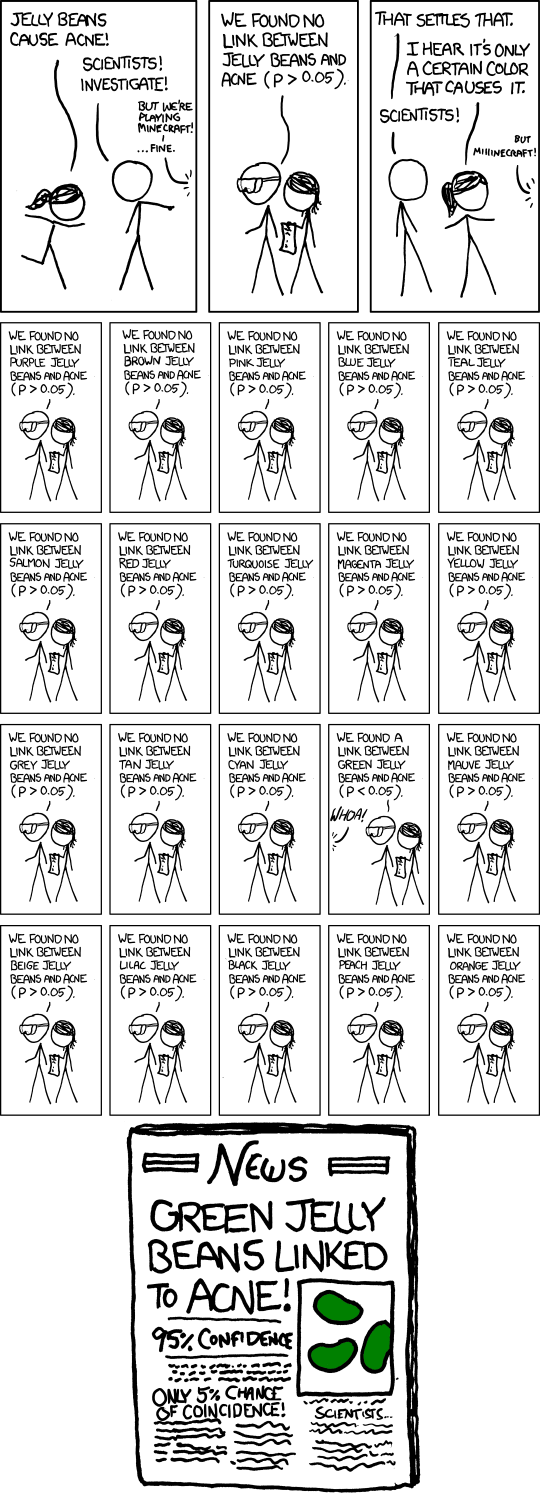
HUH? MULTIPLE COMPARISONS?